
Study · 3 min read
What Are the Four Treasures of the Chinese Study?
Brush, ink, paper and inkstone are the four essentials of the traditional scholar's desk. Here is what each contributes to writing and painting.
BAI Atelier Editorial
The Four Treasures of the Study, or wenfang sibao (文房四宝), are brush, ink, paper and inkstone. The Palace Museum groups them as the core tools of a Chinese scholar's study. They work together: a brush carries liquid ink, paper receives it, and the inkstone is the surface on which solid ink can be prepared.
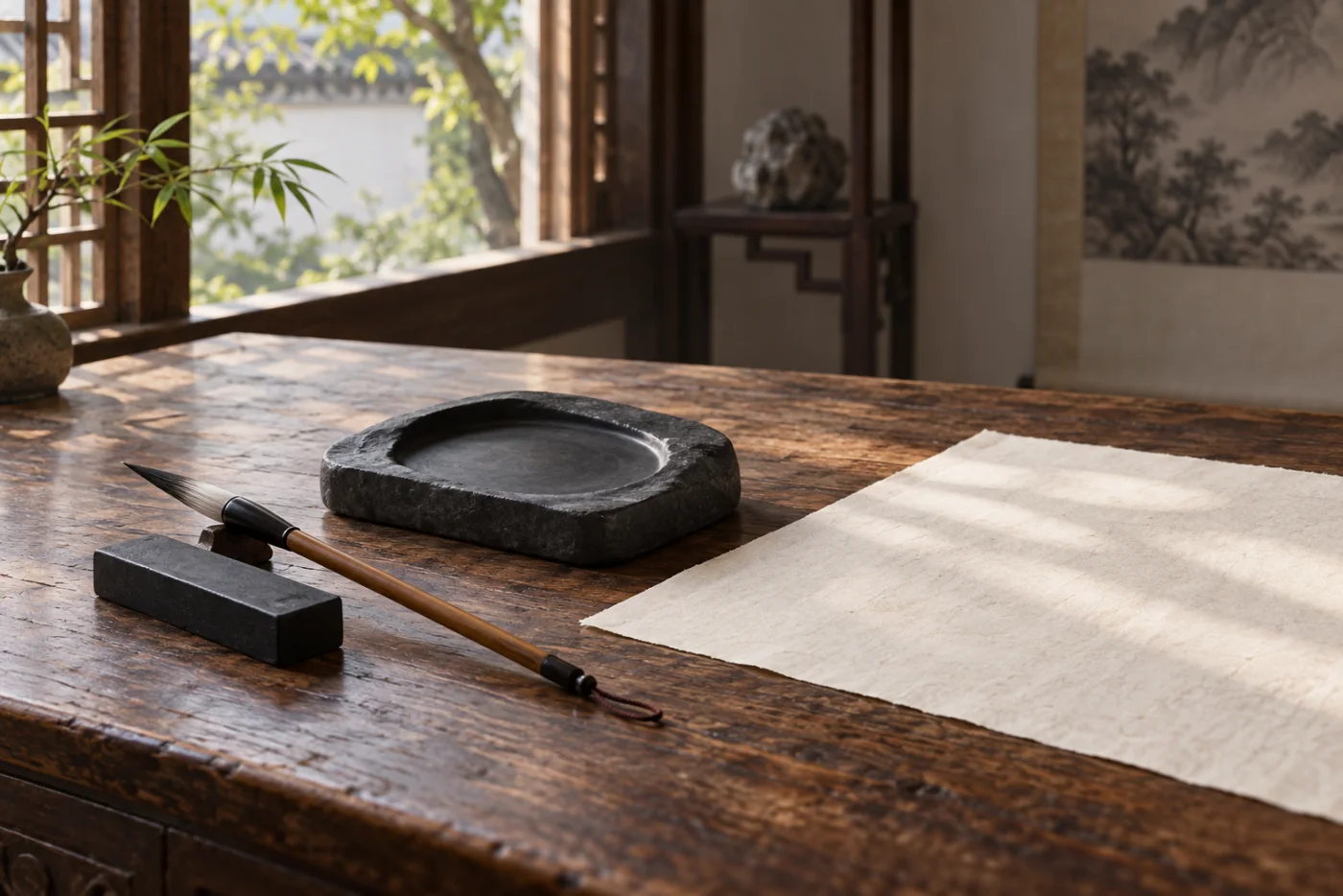
What each tool contributes
- Brush (笔, bǐ): its point carries ink; pressure and movement change the mark.
- Ink (墨, mò): a solid ink stick can be rubbed with water to prepare liquid ink.
- Paper (纸, zhǐ): the surface that receives writing or painting.
- Inkstone (砚, yàn): the surface for grinding ink and holding a small pool of it.
The Palace Museum names Hu brushes, Hui ink, Xuan paper and Duan inkstones among the best-known traditions. These are celebrated examples, not proof that every historical desk used the same set. The museum also notes that useful tools could be valued as artworks in their own right.
What belongs beside them?
A study might also hold a brush rest, water vessel, brush washer or paperweight. The Palace Museum places these among the wider family of study objects called wenfang qinggong (文房清供). They support the act of writing, but they are not a fifth or sixth member of the Four Treasures.
When looking at a study object, ask what task it helps someone perform. Is it holding a brush between strokes, carrying water to the inkstone, or keeping a sheet flat? That question reveals more than treating the entire desk as a single, timeless arrangement.
Sources
Keep reading

The Meaning of Scholar's Rocks in Chinese Culture

Inside a Jingdezhen Studio: Where Tradition Meets Today

A Beginner's Guide to Incense Rituals at Home
A Chinese Tea Table, Explained: Vessels and Everyday Practice
How Chinese Gardens Shape a View: Frames and Borrowed Scenery
How to Look at Empty Space in Chinese Landscape Painting
Incense Burner, Box and Tools: What Does Each Do?
The Craft of Wooden Windows in Suzhou Gardens
How to View a Chinese Handscroll
What Is Dougong in Chinese Architecture?
What Are Chenxiang and Guanxiang? A Guide to Chinese Agarwood
How Traditional Chinese Incense Is Made
How to Use Incense Sticks, Coils, Cones and Powder
The Six Types of Chinese Tea, Explained by Their Making
How to Brew Different Chinese Teas: Six Starting Points
How Jasmine Tea Gets Its Scent in Fuzhou
Why Does a Han Incense Burner Look Like a Mountain?
What Is Indirect Heating in Chinese Incense?
Chaozhou Gongfu Tea: A Regional Way of Serving Oolong
Song Dynasty Diancha: Tea Whisked in a Bowl
A Fragrant Pouch That Does Not Burn: Xuzhou Incense Sachets
How Did a Tang Incense Sphere Keep Its Cup Upright?
How Hand-Firing Shapes West Lake Longjing Tea
Why Is Roasting Part of Wuyi Rock Tea?
What Is Xiangzhuan, a Chinese Incense Seal?
Enshi Yulu: A Chinese Green Tea Fixed by Steam
Why Are Tieguanyin Leaves Shaken During Making?